


Artificial intelligence (AI) is accelerating the reshaping of global governance architecture, and contestation over governance standards is intensifying. Against the backdrop of great‑power rivalry, how developing countries and emerging regions can safeguard their digital sovereignty has become an increasingly important issue. The five Central Asian countries, situated in the heart of Eurasia, offer a unique window into this process.
On the morning of June 24, 2026, Dr. Farrukh Khakimov, Head of Department at the Development Strategy Center in Uzbekistan and a visiting scholar at the Center for Global AI Innovative Governance (CGAIG) and the Fudan Development Institute, gave a lecture on “AI Governance, Digital Sovereignty, and China–Central Asia Cooperation.” The lecture was moderated by Mr. Zhang Yifeng, Associate Research Fellow at the Fudan Institute of Belt and Road & Global Governance, and featured a discussion with Mr. Ma Bin, Associate Professor and Deputy Director of both the Center for Russian and Central Asian Studies and the Center for Shanghai Cooperation Organization Studies at Fudan University.

Dr. Khakimov delivers a keynote presentation.
Dr. Khakimov’s research focuses on China’s “Global AI Governance Initiative” and its implications for Central Asian countries, with a core concern over how these states can safeguard their digital sovereignty while managing external dependencies. To this end, the study employs a qualitative comparative case method covering all five Central Asian countries and draws on theoretical perspectives such as strategic hedging and multi-vector diplomacy.
He first reviewed the competing paradigms and camps in global governance, with a particular focus on China’s governance approach. Namely, since the proposal of the “Global AI Governance Initiative” in 2023, China has advocated a people-centered approach and the principle of “AI for good,” supported the United Nations in playing a central role, and called for helping developing countries bridge AI divides.
Turning to Central Asia, he analyzed the differentiated development trajectories of the five countries. Kazakhstan enacted the first comprehensive AI law in Central Asia in 2025, Uzbekistan released its development strategy toward 2030, while the other three countries are at various stages of development. In his view, these countries are not passively adopting a single external template, but rather selectively absorbing and adapting external models to suit their own needs.
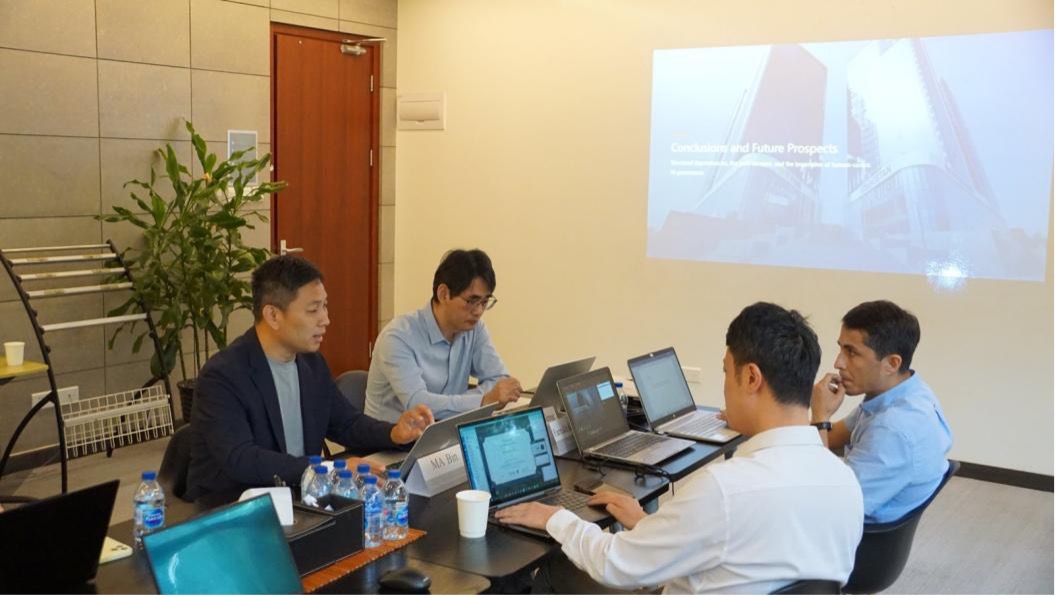
Moderator Zhang Yifeng and discussant Ma Bin engage in a discussion with the speaker.
On this basis, he pointed out that, with the support of the “Digital Silk Road” and the institutionalized China–Central Asia cooperation, AI is becoming an increasingly important pillar of bilateral relations. This cooperation is carried out largely through infrastructure investment and technology transfer, while the two sides’ shared commitment to principles such as respect for sovereignty and a UN-centered approach provides an institutional foundation for such cooperation. Central Asian countries are actively safeguarding their digital sovereignty by means of regulatory differentiation, infrastructure hedging, and multi‑vector diplomacy, avoiding full alignment with any single model.
During the discussion and Q&A session, discussant Ma Bin, moderator Zhang Yifeng, and the faculty and students present engaged in in‑depth exchanges with the speaker on topics including the prospects for Central Asian regional cooperation platforms, the market‑driven nature of China’s AI development, the practical implementation of China–Central Asia cooperation, and the internationalization of start‑ups. Dr. Khakimov responded that Central Asian countries generally adopt strategic hedging and even “strategic silence,” and tend to support UN‑based, consensus‑based multilateral mechanisms. At the conclusion of the lecture, Zhang Yifeng, on behalf of CGAIG, presented Dr. Khakimov with a visiting scholar certificate.
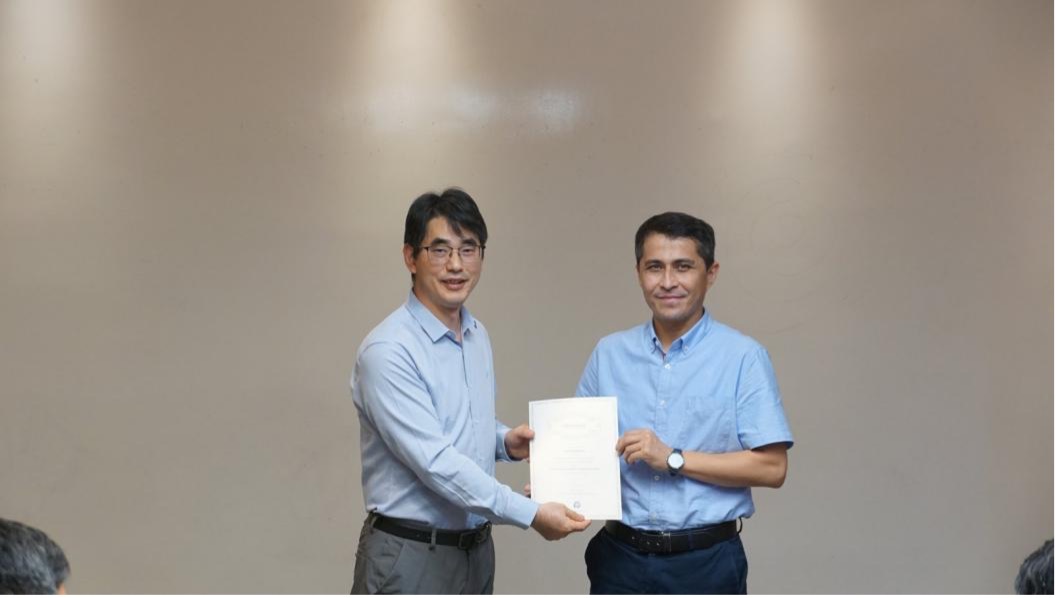
Mr. Zhang Yifeng presented Dr. Khakimov with a visiting scholar certificate.
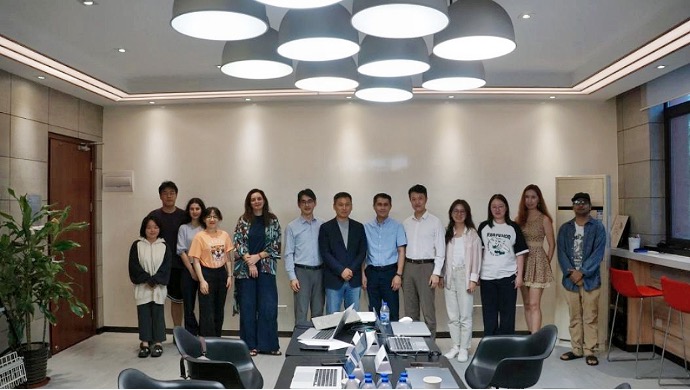
Group photo of the lecture participants.
Original URL: https://mp.weixin.qq.com/s/i_P7PC-6ZBaiDIu-RbVu9w