

On July 17, 2026, the research report Risk Transformation and Ethical Responses in the Age of ASI from the Center for Global AI Innovative Governance (CGAIG) was officially released at the forum "Global AI Governance and Sustainable Development: Challenges and Responses" during the 2026 World Artificial Intelligence Conference (WAIC 2026).
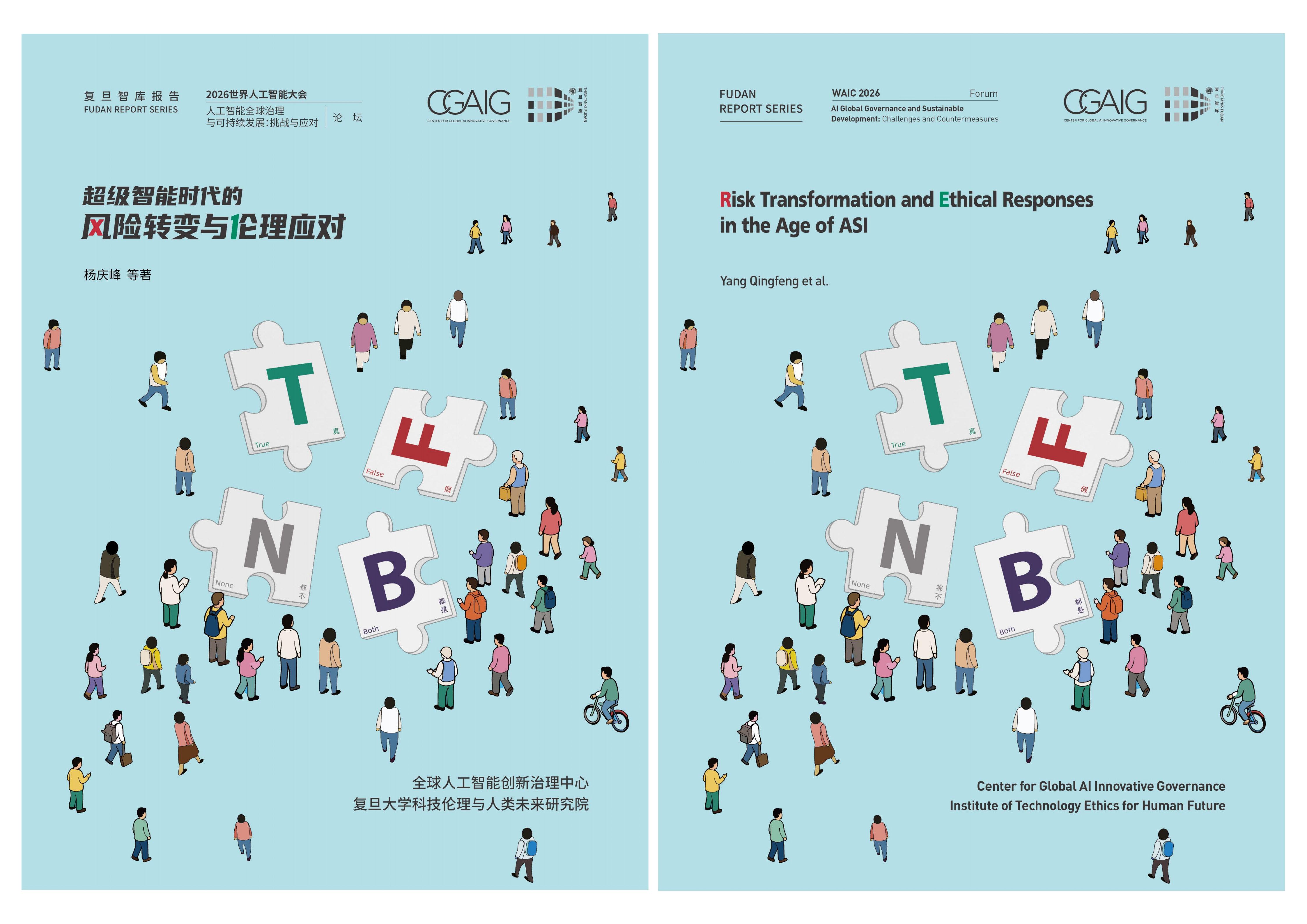
This report is co-released by the Center for Global AI Innovative Governance and the Institute of Technology Ethics for Human Future of Fudan University. Yang Qingfeng, Research Fellow at the Institute of Technology Ethics for Human Future and Doctoral Supervisor at Fudan University’s School of Philosophy, leads the writing team, which brings together 12 researchers from institutions including Fudan University, Lanzhou University, and the Norwegian University of Science and Technology. Nine scholars across disciplines such as philosophy, law, standardization, and journalism and communication serve as expert advisors: Cao Jianfeng (Shenzhen University), Duan Weiwen (Chinese Academy of Social Sciences), Fan Kefeng (China Electronics Standardization Institute), Fu Changzhen (East China Normal University), Liu Yongmou (Renmin University of China), Pan Ji (Fudan University), Wang Qingjie (University of Macau), Yan Hongxiu (Shanghai Jiao Tong University), and Zhang Ping (Peking University). Wei Zhongyu from Fudan University’s School of Data Science and Angelo Cangelosi from the University of Manchester’s School of Engineering serve as scientific advisors.
The full report comprises six sections in sequence: The Evolution of AI Ethics: Pathways, New Features and Turn, Risk Characteristics in the Age of Superintelligence, Theoretical Dimensions of Intelligent Contract Ethics, Practical Pathways of Intelligent Contract Ethics, Ethicist AI for Addressing Spherical Risks, and Conclusion. It is attached with three appendices: Compilation of Representative Global AI Ethics Regulations and Principles (2020–2026), Engineering Manifestations of Global Intelligent Contract Ethics, and Glossary of Report Terms.
The report points out that the academic temperament of contemporary AI ethics, which pursues the law of freedom, is increasingly diminishing, while the trends of legalization, institutionalization and engineering orientation are notably growing. AI ethics can be categorized into technology-oriented AI ethics and humanistic-oriented AI ethics, and its construction must shift from product thinking to practical thinking.The report argues that superintelligence brings not an "upgrade of being", but a "leap of being", and the premises of continuism, instrumentalism and hierarchism on which traditional risk theory relies are failing one by one. Drawing on Peter Sloterdijk’s Spheres Theory, the report profoundly points out that AI risks have evolved into a structural problem at the ontological level, presenting as existential spherical risks: the interaction between humans and AI forms a new spherical structure, and risks are no longer external shocks, but the tension and instability inherent within this structure.
To address the aforementioned challenges, the report creatively establishes the theoretical framework of Intelligent Contract Ethics. It holds that in the age of superintelligence, the relational ethics between humans and machines should break away from the binary opposition between humans and machines, and concluding ethical contracts between humans and intelligent robots is a viable solution: dynamic contracts are deployed to monitor ethical frictions, suspended conflicts are subject to human deliberation under a four-valued logic framework, and a Multi-stakeholder Ethics Committee (MAEC) is set up to ensure the final decision-making authority rests with humans.Looking ahead to the future human-machine symbiotic society, the report proposes a practical paradigm of developing Ethicist AI with intelligent contracts as its core to act as contract constructors. The system comprises three core components: a value perception layer, a conflict arbitration module and a self-correction loop. The report further outlines a phased implementation roadmap and quantitative evaluation indicators, progressing from foundational construction and regional piloting to global expansion.
Released alongside the main report is a companion volume entitled Reassurance and Empowerment: The Dual Dimensions of AI for Good. The volume presents a systematic academic elaboration of the philosophy "reassure the public and empower humanity" proposed by Tencent Research Institute. It points out that the two are not goals of equal weight, but form a unified ethical structure with inherent tension, where "reassurance defines the bottom line and empowerment sets the direction". Specifically, it constructs the institutional conditions for subjectivity protection under the "reassuring the public" framework through three progressive dimensions—interpretability, intervenability and traceability—drawing the minimum ethical baseline for human-machine relations. Meanwhile, it clarifies the normative boundaries of technological enhancement for "empowering humanity" based on three tiers of standards: capability, value and spirit.Drawing on the Theory of Technological Enlightenment, the companion volume unpacks the dual structure of "coexisting promise and cost" behind AI cognitive intervention. Through a critical analysis of megamachine risks, it advances the discourse on AI ethics from superficial technical regulation to a profound examination of power structures and the trajectory of civilization, which forms a conceptual echo with the intelligent contract ethics framework in the main report.
As a follow-up study to Superintelligence: A Minority Report released at the Shanghai Forum in April 2025, this report builds upon prior discussions on technical and philosophical responses, and further puts forward more concrete ethical response initiatives. It aims to provide a theoretical foundation and actionable governance solutions for the new human-machine relationship brought about by superintelligence, and lay the theoretical basis for the implementation of the United Nations Global Digital Compact.
Project Team
Expert Advisors
Cao Jianfeng · Shenzhen University
Duan Weiwen · Chinese Academy of Social Sciences (CASS)
Fan Kefeng · China Electronics Standardization Institute (CESI)
Fu Changzhen · East China Normal University
Liu Yongmou · Renmin University of China
Pan Ji · Fudan University
Wang Qingjie · University of Macau
Yan Hongxiu · Shanghai Jiao Tong University
Zhang Ping · Peking University
Scientific Advisors
Wei Zhongyu · School of Data Science, Fudan University
Angelo Cangelosi · School of Engineering, University of Manchester
Writing Team
Chen Danni, Cheng Yu, He Teng, Li Kaiyang, Qiu Dejun, Xu Hanhui, Xu Zhihong, Yang Qingfeng, Yang Yang, Zhang Ruiyuan, Zhou Zhengyang, Zhu Linfan
Original URL:  Risk Transformation and Ethical Responses in the Age of ASI.pd